
When someone searches for a local business on Google, three listings appear at the top of the page which sit just above the organic results. This is the Google 3-pack – prime real estate for any business hoping to attract nearby customers.
If you run a local business, securing a spot in the 3-pack can be the difference between being found and being forgotten. And you don’t need a huge budget to compete. With the appropriate planning and approach, you can climb your way into those coveted top three positions.
Here is what you need to know about Google 3-pack in order to rank there.
What is the Google 3-pack?
The Google 3-pack (also called the local pack or map pack) is a feature in Google’s search results that displays the top three local business listings relevant to a user’s query. These results appear alongside a map and include key details like the business name, address, opening hours and star rating.
For example, if someone searches ‘best coffee shop near me’, the 3-pack will show three top-rated local cafés, complete with a clickable map for directions.
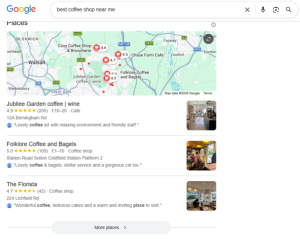
Each of these signals’ local intent – someone in a specific area looking for a specific service. Because of where the 3-pack sits on the page, it puts your business directly in front of customers who are ready to buy. The local pack also has one of the highest click through rates (CTR) of any rich results, with 17.6% for first place and just over 15% for second and third place.
Why this matters for local businesses
Landing a spot in the 3-pack gives you more visibility. It appears above traditional organic links, which means it’s more likely your business will be seen. This prime placement can lead to more customers, as people are more inclined to visit your site, call you, or pop into your shop when they see your name at the top. Securing a place here signals to searchers that Google considers your business credible.
It’s also one of the most cost-effective marketing tools out there. Listing in the 3-pack is free, and research shows that 78% of local mobile searches result in an offline purchase. That’s a huge opportunity for businesses willing to put the work in.
How to rank in the Google 3-pack
Google decides which businesses to feature based on three main factors:
- Proximity: How close your business is to the searcher. While you can’t control where someone is standing, accurate location details help Google understand where you operate.
- Relevance: How well your business matches the search query. The completer and more detailed your information, the better Google can connect you with the right people. You don’t want to see a listing for a plumber when you’re looking for coffee!
- Online presence: Your overall reputation, including reviews, citations, and your Google Business Profile.
Get these three elements right and you’ll give yourself a strong chance of cracking the top three.
Optimising your Google Business Profile
Your Google Business Profile is fundamental to any local ranking strategy. To appear in the 3-pack, you’ll need a verified profile that’s complete and regularly updated.
Start by claiming your listing. Search for your business name in Google and if an existing listing appears, click ‘Own this business?’ to claim it. If nothing comes up, you’ll need to create one from scratch. Either way, Google will guide you through the verification process which usually involves a code sent to your email or phone.
Once you’re verified as the owner of your profile, it’s time to optimise. Make sure to:
- Keep your details accurate and consistent, especially your name, address, and phone number (NAP). This matter across any other listings you have too, such as Bing or directories like Central Index or Scoot.
- Choose the right category so Google knows exactly what you offer. Although you might be restricted to what Google allows you to enter, make sure it’s the most relevant.
- Add a detailed description that includes relevant keywords, as well as information about your business and your offerings.
- Upload high-quality photos of your premises, team and products. Don’t forget to add your logo and keep it updated if you ever change.
- List your services or products with prices where appropriate. Include detailed descriptions of each service, another chance to get your target keywords in.
- Post regular updates and offers, just as you would on social media. This is perfect for promotional offers and seasonal opening hours.
Remember to revisit your profile often. Google allows users to suggest edits, so checking in regularly ensures no one changes your information without you noticing. This is as easy as searching for your business and checking all the categories for updates.
The importance of local keywords
Local keywords are the phrases people type when searching for a service in a particular area think ‘divorce solicitor in Manchester’ or ‘vegan food in the Birmingham city centre.’
Weaving these naturally into your website, business description, and content tells Google your business is relevant to that location – the key word being naturally. There’s a fine line between using keywords well and keyword stuffing, which can harm your rankings rather than help them.
To find the right keywords, use a keyword research tool. Focus on terms that combine your service with your location, then build content around them. Such as location-based service pages, blog posts or FAQs. You can link all this content in updates on your Google Business Profile.
Leveraging customer reviews
Reviews are one of the strongest signals Google uses to decide who appears in the 3-pack. The more positive and recent reviews you have, the better your chances.
It’s worth the effort too, 88% of consumers trust online reviews as much as a personal recommendation. To make reviews work for you, ask customers for feedback at the right moment, like after a successful purchase or completion of service, and share a direct link to your review form to make it effortless. You can also add a friendly request to your follow-up emails. Make sure to respond to every review, good or bad, as a polite and professional reply says a lot about your business to potential customers.
Avoid offering incentives for reviews however, as this goes against Google’s guidelines. Keep your approach natural and let your service speak for itself.
Maximise your local visibility
The Google 3-pack is one of the most powerful tools available to local businesses and getting there doesn’t require deep pockets. By optimising your Google Business Profile, targeting local keywords and building a steady stream of positive reviews, you’ll send Google all the right signals about your relevance and trustworthiness.
Start with the basics, stay consistent and keep your profile fresh. Local SEO is a long game, but the rewards are well worth it.
Looking for support with your local SEO? WorkPR are here to help. Get in touch today and let’s get your business moving on up in local search.
